As a scientist, it might surprise you to learn that I trained in Reiki more than 25 years ago.
It wasn’t nearly as popular then as it is now.
I can recall the Reiki master who led my training telling me that there were just 8 Reiki masters in Glasgow at the time. That’s where I did my training – Glasgow, in the UK.
I don’t know whether it was true or not, but it does reflect that fact that there were few people trained in Reiki at that time. At least compared with nowadays.
Even scanning the scientific databases, there were only a handful of studies on Reiki at that time. Now there are thousands.
And as is often the case – and it certainly was this way with Reiki – stuff is initially dismissed as ‘woo-woo’, but often moves in the direction of mainstream once more science becomes available.
I thought I’d share one new study with you that I found particularly insightful. It’s recent – from 2025.
People with knee osteoarthritis received Reiki or did mindfulness meditation. It was a placebo-controlled randomised controlled trial, which makes it exciting from a credibility perspective.
Now you might think – how can you have a placebo group when we’re talking about Reiki?
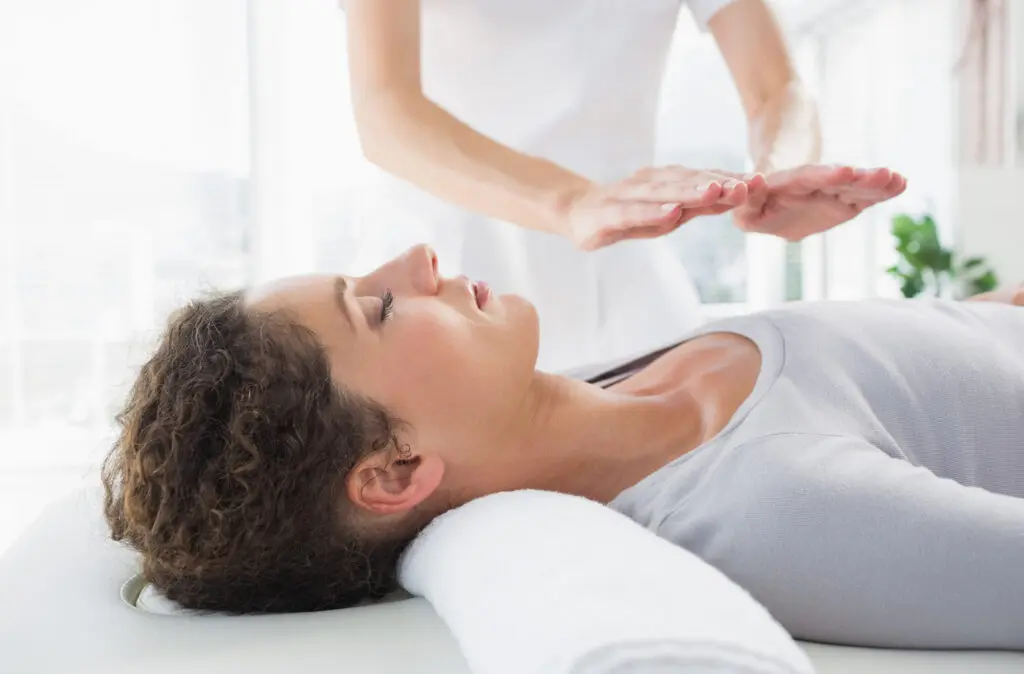
Well, in science, placebo Reiki is sometimes called ‘Feiki’ – as in fake Reiki – or it’s sometimes called ‘sham Reiki’, ‘placebo Reiki’, or ‘mimic Reiki’. Here’s the premise: an actor who is not trained in Reiki is taught to make the same movements, in the same way, at the same times, as a Reiki practitioner.
That way, if Reiki that’s delivered by a trained practitioner outperforms Feiki, then it’s evidence that Reiki is effective, just like if a drug outperforms a placebo the drug is considered effective.
The study recruited 164 clinically diagnosed knee osteoarthritis patients, and involved researchers from Florida State University, University of Utah, Brigham and Women’s Hospital, Harvard Medical School, the University of Michigan, and UC San Diego.
The volunteers were randomised into four groups – Reiki, Feiki (sham Reiki), mindfulness, or a waitlist control (who don’t do anything – for comparison).
The results?
Those who received Reiki or who did mindfulness experienced significant reductions in pain: 55% of those in the Reiki or mindfulness groups experienced clinically significant pain reductions compared with only 20% in the Feiki group and 13% in the waitlist control group.
Conclusion?
Reiki worked for reducing pain. And so did mindfulness.
I’m focusing on Reiki in this blog, but I would like to first say a few words about mindfulness.
Mindfulness
Managing pain was the first clinical use of mindfulness meditation when it made its entry in Western Medicine.
In 1979, Jon Kabat-Zinn convinced directors at the University of Massachusetts Medical Centre (now UMass Memorial Health) in Boston to allow him to trial mindfulness in a group of outpatients whom the hospital didn’t seem able to help.
And it worked – significantly so.
So much so, in fact, that within a year the mindfulness program was invited to become an official part of the Department of Medicine at the hospital.
Through Kabat-Zinn’s pioneering work, mindfulness began its shift from woo-woo to mainstream – or from ‘woo-woo to true-woo’, as I like to reference these sorts of transitions.
How does mindfulness reduce pain?
Mindfulness encourages us to notice pain without leaning into it. We develop a relaxed non-judgmental awareness of it. It takes a bit of practice, of course, as most things do, which is why the original course ran for 8 weeks. But with practice, it is possible to detach somewhat from an experience of pain.
How does Reiki work?
With Reiki, clearly something significant is also going on because the Feiki practitioner made all the same movements during the same time period, but far more patients who received the actual Reiki treatment had clinically significant reductions in pain.
Several mechanisms have been suggested for how Reiki works.
First, it’s a biofield therapy, and biofield therapies are believed to assist the body’s own healing mechanisms. It means that while a person is receiving Reiki, some of the body’s systems work more optimally.
A net result of this can be a reduction in pain, as well as improvements in other ways.
Most practitioners also believe a universal life force is channelled through the practitioner.
To some who are sceptical, this might sound a bit ‘out there’, but let’s consider a few things. Understandably, life force energy isn’t something science has attempted to measure because it doesn’t have a physical substance that can be measured. Which is why some dismiss it.
However – there is now a huge amount of data supporting the idea that consciousness is not produced by, nor contained within, the brain. Data in support of psi phenomenon (ESP, telepathy, remote viewing, precognition), for example, is now overwhelming according to the most up-to-date meta-analyses.
Viewed from this perspective, life force energy is essentially part of us – all of us, including a Reiki practitioner and a client – and is not confined to the brain or either. It is an aspect of our consciousness.
Thinking from this perspective, it is easier to appreciate that life force energy can flow between a Reiki practitioner and a client. Indeed, it must flow between you and anything you put your attention on because attention is the act of focusing your conscious awareness.
Allowing it to channel through you is, from this perspective, like conscious breathing. Different healing modalities (Reiki, Therapeutic Touch, etc) then, are akin to different breathing techniques.
Reiki works
So I think a number of things are going on in a Reiki session. From a physiological perspective, Reiki helps our physiology move towards a state of balance and calm by assisting the body’s own natural healing mechanisms.
But at a deeper level, I do believe there is a channelling of universal life force energy – that is, the energy (or consciousness) of life itself.
But setting aside questions and debate on how Reiki works, the point is that studies do show that Reiki works.
And that can be a comforting thought to those who wish to receive a Reiki session.
References:
Reiki study. View here.
Psi research (published in American Psychologist. View here.
Deeper piece in International Review of Psychiatry (2025). View here.
Read more on the science of channeling, what it is, how it works (book by Helané Wahbeh, Director of Research at IONS – Institute of Noetic Sciences). View here.
More on mindfulness, its roots, history, & science, from Chapter 1 of my book, ‘The Joy of Actually Giving a fck’. View here.
Why Woo-Woo Works
Learn more about the science and research on Reiki in my book, ‘Why Woo-Woo Works‘ or check out my 6-month online course exploring the science of Reiki, the mind-body connection, biofield therapies, psi research, and more. Check it out here.

As Reiki practitioner this study just confirms what we already know and believe. However, for those that don’t believe in it, it’s something they need to consider! Thank you.
Read is reiki more effective than plabo at treating symptoms of mental health? S Zadro
I understood about reikhi.
One has to have a certain amount of belief only then will this work
Do it with fervour and then see what happens.