
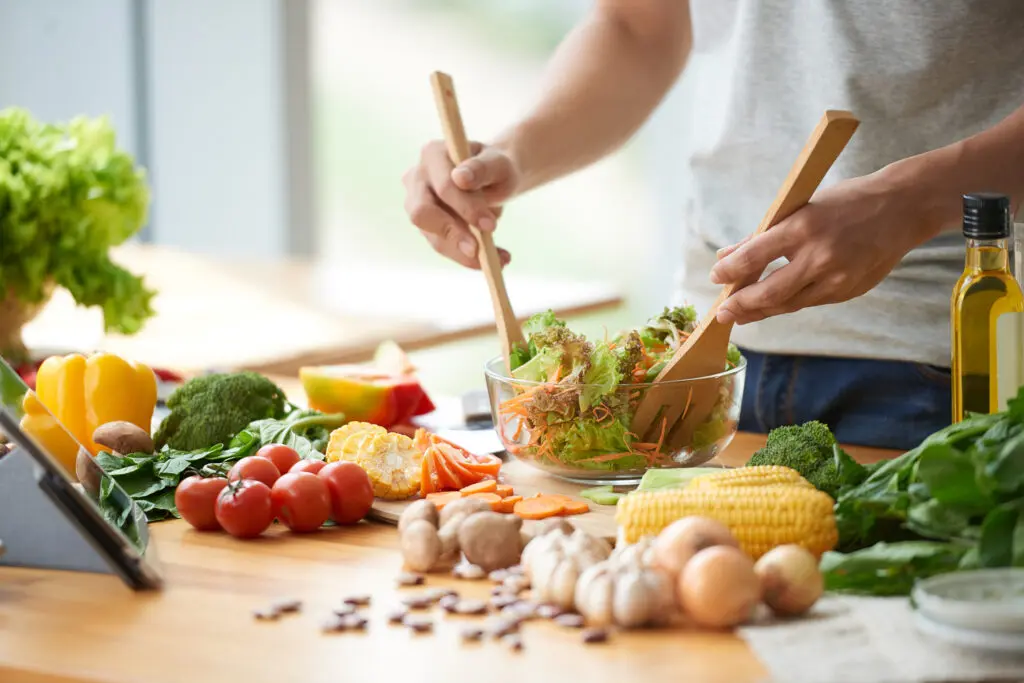
A new study links home cooking with lower dementia risk.
Wellness advice often focuses on what we put on our plates – the ingredients – but new research suggests we’ve been overlooking the role of how those ingredients came to land on our plates in the first place.
Enter the power of cooking meals from scratch!
Even if you only do it once a week.
Researchers at the Institute of Science in Tokyo, Japan, tracked the behaviour and health of 10,978 people aged 65 and older for over 6 years.
It turned out that those who cooked at home from scratch at least once a week had a roughly 25-30% reduced risk of dementia.
But that wasn’t all. It also depended on how skilled they were at cooking.
And this is where things take an unexpected twist.
The study revealed what’s sometimes called a ‘novice effect’: the protective effects were greatest in people who had few cooking skills.
Cooking from scratch at least once a week reduced their risk by around 65-70%.
This was an observational study, so it doesn’t prove that cooking prevents dementia – but it does show a strong association.
What’s going on?
That’s the big question.
The researchers suggested that preparing a meal from scratch is cognitively stimulating.
And even more so if you’re not very skilled at it.
What this tells us is that it’s the cognitive demand – that is, the planning meals, sequencing steps, timing things, adapting when something goes wrong – that’s doing the heavy lifting in terms of brain health.
So what does this mean for people who are good cooks, where cooking from scratch feels relatively easy? One answer is to try new dishes – to challenge yourself more.
Experiment.
Occasionally try a different style or flavour combination.
Challenge and novelty matter.
Other factors?
The researchers also suggested that a contributing factor was the physical movement of going to the shops to buy the ingredients for the dish.
Their argument is centred around the rise in ‘takeaway culture’ – people are ordering takeaway more often nowadays, and so the shopping component of people’s weekly exercise numbers is reducing.
Plus, there’s a contribution from eating healthier. Meals cooked from scratch are typically healthier than takeaway or pre-packed. Not always, though, as it depends on what takeaway you’re ordering or what pre-packed meals you buy.
And there’s also the mindful prep of the meal. Mindfulness is a protecting factor for brain health.
This is where I’d like to personally suggest another contributing factor.
Smell.
A major factor in cooking.
The smell of fresh ingredients
Hear me out.
Scent is processed differently from our other major senses. Sight, sound, touch, and taste are processed via a central hub in the brain (the thalamus) before being passed on to different brain regions.
But scent has its own direct link to memory, cognitive, and emotional regions. It’s sometimes called the smell superhighway. It’s why smells can conjure up clear and powerful memories.
Studies have now shown that loss of smell sensitivity (known as olfactory dysfunction) is linked with cognitive decline, Alzheimer’s, and over 100 other conditions.
In other words, if the pathway isn’t regularly stimulated, it may weaken over time.
But smell training, on the other hand – smelling things on purpose – has a protective effect.
A review of 18 controlled studies found that smell training (i.e., practice) was associated with improved cognition, verbal fluency, and verbal learning and memory.
Smell training trains neural circuits in the above regions – for memory and cognitive function.
If you’re interested in exploring this more, I wrote a blog on it recently.
But whatever the main factors – cognitive demand, exercise, mindfulness, smell of ingredients – the evidence suggests that cooking from scratch may support brain health and offer some protection against dementia.
Try this
-If you don’t (or rarely) cook from scratch, set yourself a challenge of cooking at least one meal from scratch per week for the next month. It doesn’t need to be complex, but may require planning, especially if you have a busy life. Use the fact that it will boost your brain health as a motivator.
-If you regularly cook from scratch, set yourself the challenge of cooking one brand new dish per week for the next month.
-Each time you cook from scratch, take a moment to enjoy a deep inhale of each of the ingredients you use – from the herbs or spices, to the oils, to the main ingredients.
Sometimes the most powerful things we can do for our brain aren’t high-tech or complicated.
They’re simple, human… and already part of daily life.
Want to explore more?
I always make a YouTube video based on these Better You, Backed by Science emails.
If you’d like to view this one, where I dive a little deeper into the science, here’s the direct link.
And here’s a link to my entire Better You, Backed by Science playlist, with a video on every single previous email going back to the middle of last year.
References
The cooking study. Link
Smell training improves cognition. Link
My blog on smell – how it works, the science, and how smell training protects the brain. Link.
More
Want to read more like this? Subscribe to my free Better You, Backed by Science weekly email (sends every Wednesday).