
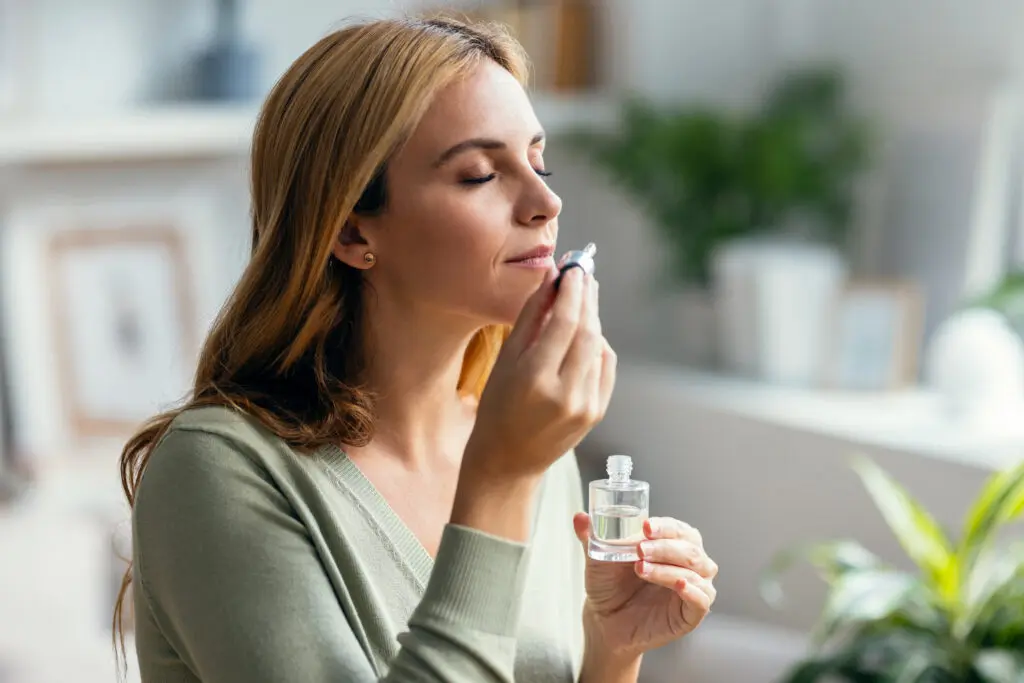
Why Aromatherapy Works: The Science of Smell
I had a spa day a few months ago.
It was a birthday present and included a massage.
The masseuse offered me the choice of two oils that she could use. I sniffed both and made my selection. It was a good choice for me, she said, given what I’d indicated in the form I filled out beforehand.
I’d wrote that my leg muscles were feeling tight because I’d played a strenuous tennis match the day before. She said the oil had anti-inflammatory properties.
Now, it’s easy to dismiss such a claim. Aromatherapy sounds woo-woo to anyone who doesn’t know of research in the field.
But the science of scent is really quite compelling.
Odour has significant effects on the brain and body, and it all starts with the way smell is processed in the brain.
The Scent Superhighway
Our sense of smell is processed quite differently from our other major senses.
Sight, hearing, taste, touch are processed through a central relay hub in the brain (thalamus) before being sent onto their various destinations.
Think of it like trains all coming into a central train station in a main city that connects to other stations around the country. If you’re travelling on, you have to get off your train and walk to another platform to board a different train that’s going to your destination.
But smell does things differently.
Smell bypasses the thalamus altogether.
It has its own superhighways that go direct to its destinations, making things much faster and unfiltered.
Odorous chemical compounds are inhaled through the nose and information is transmitted to the olfactory bulb, a structure that lies just above the nasal cavity and at the base of the forebrain. This is where all the superhighways start out.
From there, there’s direct routes to regions involved in emotional processing (amygdala) and memory (hippocampus) as well as areas involved in learning, cognition and decision making (orbitofrontal cortex and connected regions).
It’s why smells can sometimes arouse such powerful emotions or memories. Sometimes when I’ve caught the scent of a pipe being smoked, I’m immediately back in my Granny and Papa’s living room as a child and my Papa is puffing on his pipe. I even see my Papa’s face, what he’s wearing, and what my older sister and I are wearing. I also see the layout of the room and the furniture. It’s like I’m there.
Smell and Cognition
There’s now a very well-identified link between smell sensitivity, memory, and cognition. It tells us that using our sense of smell is important for the health of the brain.
Improvements in smell sensitivity, in fact, can lead to improvements in memory and cognition.
Losses in smell sensitivity, on the other hand, can lead to weakening in these abilities.
In fact, researchers can even use smell sensitivity tests as an identifier to predict a person’s risk of cognitive decline.
When they examined the records of 497 people, researchers at San Diego State University and San Diego School of Medicine found that odour sensitivity could predict a person’s risk of mild cognitive impairment and even Alzheimer’s. It was more accurate even than the widely used Mini Mental State Examination.
A much larger analysis, the LIFE-Adult-Study in Germany, found the same thing. It involved 6,783 people who underwent smell testing (sensitivity to various odours) as well as tests of their mental abilities.
It found that the weaker a person’s sense of smell, the worse they scored in tests of cognitive performance, including memory.
Why is loss of smell sensitivity – also known as olfactory dysfunction – related to cognitive decline?
Researchers believe it may be because if smell sensitivity weakens, then so also does the brain stimulation that accompanies it.
If we’re not using our sense of smell, the brain regions that it stimulates and trains don’t get that same stimulation. So they weaken, like a muscle we don’t exercise.
Indeed, studies now show that olfactory dysfunction – a disturbance in our sense of smell, ranging from partial loss to total loss – is related to loss of grey matter volume in key brain regions associated with cognitive performance and memory.
Loss of smell has now been linked with 139 conditions, including cardiovascular disease, arthritis, polycystic ovary syndrome, Parkinson’s Disease and Alzheimer’s.
But recent research suggests that smell training might be able to help. Just as we go to the gym and do reps, we can do “reps” of smelling.
Smell Training
Consider the following study. A randomised controlled trial of 70 patients with Parkinson’s Disease was conducted in 2025. Half were exposed to the scent of essential oils daily for 6 months while the other half weren’t.
After the 6 months, those who inhaled the essential oils had significant improvements in their sense of smell, but also in their memory and cognition scores, as well as reductions in depression and anxiety.
A review of 18 controlled trials recently concluded that smell training leads to improvements in overall cognition, verbal fluency, and verbal learning & memory in particular.
And these studies didn’t necessarily all involve people with impaired smell, but people with what we think of an average, normal sense of smell. They also saw gains in cognition and memory.
According to brain scans, these gains were accompanied by significant physical changes in brain regions, including the olfactory bulb, hippocampus (memory), and increased connectively with other important brain regions related to cognition and mental performance.
Smell training in these studies typically asks people to smell a handful of essential oils for about 10 seconds each, twice a day. Others use a diffuser containing a single oil or mixture of oils.
In a study at the University of California at Irvine, 43 people aged between 60 and 85 were asked to turn on the diffuser when they went to bed, so it diffused scent while they slept. Each night featured a different scent (rose, orange, eucalyptus, lemon, peppermint, rosemary, and lavender).
Incredibly, there was a 226% gain in verbal learning and memory after 6 months of nightly use.
Six months might sound like a long time to train your nose, but when we train to get physically fit, we don’t just do a couple of gym sessions and that’s us now super fit. We have to keep it up.
Sometimes, significant gains take a few months or more to become obvious. It’s the same with smell training. Although results do often come more quickly.
The key with smell training is to make smelling a habit so it doesn’t feel like training.
Aromatherapy
So where does this leave us with aromatherapy?
As a scientist myself, when I began to study this research, the first thing I personally did was purchase a range of essential oils and a diffuser.
Each time I walk into my office, I’ve now made it a habit to open half a dozen bottles of essential oils and take a deep inhale of each. We also use a diffuser every day that spews out mixtures of oils.
I do this because I know it’s good for me. It’s backed by science.
And not just for memory and cognition. The effects of scents go farther. Signals don’t just stop at emotion, memory, and cognition centres. They trigger effects all throughout the brain and body.
And if you receive a massage, like I did, some effects come from absorption into the skin. Molecules in the oil (the phytoconstituents) are absorbed through the skin during massage (10-40 minutes post application), eventually reaching the blood, and passing through the blood-brain barrier and into the brain.
For interest, here’s a brief spotlight into some of the most popular and well-studied oils.
Lavender and some other popular oils
The most well studied of the essential oils is Lavender. Numerous studies show that it promotes a sense of calm, improves sleep, and even reduces pain.
Specifically, it helps calm the nervous system by activating the brain’s GABAergic system. It’s the main inhibitory neurotransmitter network. It helps it slow nerve signals and thus promote a state similar to that induced by anti-anxiety medications.
At the same time, lavender also increases parasympathetic activity (that’s the rest and digest portion of the autonomic nervous system), generating an overall calming effect.
Lavender also helps to normalise vital signs, including blood pressure, heart rate, and respiratory rate, which has led to its use in helping to calm patients before and after surgical procedures.
Camomile (chamomile) also has calming effects. One of its components is a flavonoid called apigenin, which also interacts with the GABA system to promote a sense of relaxation.
Camomile also contains compounds (bisabolol and chamazulene) that relax smooth muscles. And it has anti-inflammatory properties.
While lavender and camomile can relax us, rosemary has been shown to improve alertness and cognitive function, peppermint can soothe pain and ease nausea, and eucalyptus (thanks to its camphor-based compounds) can help reduce nasal congestion.
There’s volumes of research on the effects of many different oils and much more is needed.
My focus in this blog isn’t about which oils do what, except to offer a flavour, so to speak, but more to outline the science behind how and why scents have effects.
So how do we use this information?
Try This
Here’s a few ways that you can train your sense of smell. It’s about intentionally using it.
1) Try what many of the research studies do for a brain workout. Pick half a dozen essential oils and inhale them for 10 seconds or so, twice a day. If that seems like a lot to do (we easily forget to do things that are good for us), then try putting some drops into a diffuser and letting it diffuse the scent into the air.
You could even put it in your bedroom and start it when you go to bed at night.
2) Another way to train our smell is to cook with fresh ingredients. Cooking with fresh, natural ingredients allows you to inhale a multitude of scents. Inhale herbs, spices, fruits, vegetables. Make a point of smelling the foods. The more ingredients you use, the more smell training you can do.
3) When you’re out and about, make a point of noticing the scents around you. Grass, trees, flowers, people’s perfumes or aftershaves, the air itself.
More
Take a deeper dive into this, plus the mind-body connection, biofield therapies, and the science behind other alternative and spiritual practices, check out my 6-month online course: Why Woo-Woo Works.
For more science-backed insights, tools, and strategies for thinking, feeling, and living better, sign up for my weekly Better You, Backed by Science email (sends every Wednesday).
As an Aromatherapist I know this and it thank you for helping to spread the word about the science and magic of Aromatherapy!
Hi David,
A quiry for you re smell. My dad and his brother were identical twins. From my childhood I remember dad telling me that he had no sense of smell at all. I never asked uncle but assumed that he had none either. Both were very bright and competent, with high levels of practical and artistic skills. Dad lived to be 103 and uncle to 96. My brother and I have excellent smell sense at 82 and 88. How do you assess this.
Wow! My husband lost his snse of smell we think from Covid and since his memory and cognitive abilities have gone down hill.
We are waiting for memory clinic help and he has a brain scan next week however now I will use some oils too to try and help. The diffuser will help us both at night I am sure.
You have given me hope that there is a possible improvement to be made. Thank you so much.
This is really interesting. Be careful if you have a dog or cat in your household as some essential oils are toxic to the livers of our pets and may cause them to become unwell. Some research in how to use essential oils safely is a good idea.
years ago, i used to sell essential oil as part of a skin care brand. The customer would smell the oils to choose what they were drawn, they always chose the one their skin/body needed naturally.
I always have rosemary during tests/study or focus.
Another health abd safety tip is caution as not all oils are suitable during pregnancy.
❤️ thank you
My friend lost her senses of smell and taste from long covid. Several stellate ganglion shots seemed to help a bit, but the affect never lasts. Even if the smell doesn’t register, would it be helpful to still try?